
Meta Ads Agency Account vs Personal Ad Account: Which Is Right for Your Business?
Written by the Pinnacle Media team · Published 5 August 202612 min read
Pinnacle Media provides managed agency ad accounts. This guide explains both options honestly, including when a personal ad account is the better choice.
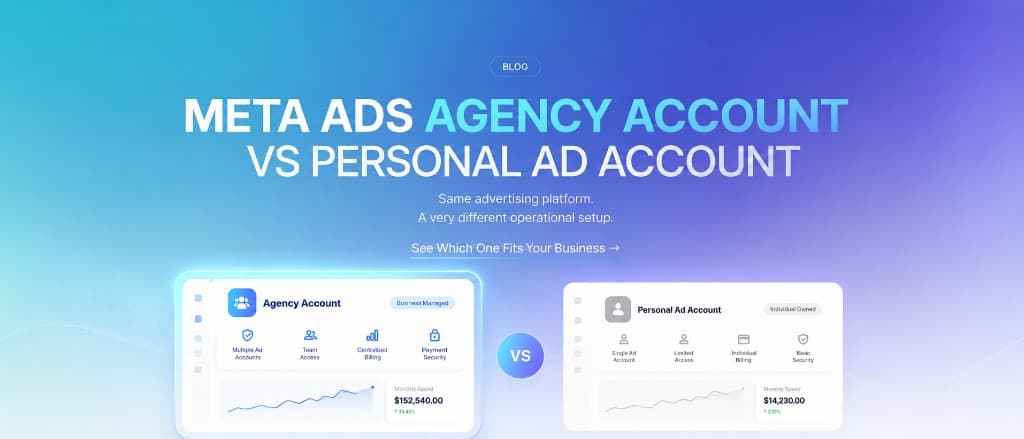
A Meta Ads Agency Account is an advertising account supplied and managed through an agency or specialist provider, with structured permissions, funding and top-up support, compliance screening and a defined process for handling account issues. A personal ad account is the standard account you create yourself inside Meta Business Manager, where you handle billing, access and problems on your own.
The short answer: use a personal ad account while you are testing Meta Ads on a small budget. Move to a Meta Ads Agency Account once advertising becomes a revenue-critical channel — typically around $20,000 or more per month, or when you manage multiple clients, markets or currencies.
The difference is not campaign features. Both run the same ads on the same platform. The difference is the operational layer around the account: who funds it, who fixes it, who is accountable when something breaks at 2am on a Saturday.
Quick summary
| Personal ad account | Meta Ads Agency Account | |
|---|---|---|
| Best for | Testing, local businesses, low spend | Scaling brands, agencies, media buyers |
| Typical spend | Under a few thousand per month | $20,000+ per month |
| Setup | Self-managed, minutes | Managed onboarding |
| Billing | Your card, your problem | Coordinated funding and top-ups |
| Support | Standard Meta support routes | Named provider contact |
| Compliance | Entirely your responsibility | Screening and guidance before launch |
| Continuity | None by default | Documented incident process |
| Cost | No fee beyond ad spend | Setup, retainer or percentage of spend |
Bottom line: a personal account gives you a place to run campaigns. An agency account gives you the infrastructure that keeps campaigns running.
Table of contents
- What is a personal Meta ad account?
- What is a Meta Ads Agency Account?
- What is the real difference between them?
- Full comparison table
- How does billing differ?
- What support do high-spend advertisers actually need?
- Why shouldn't agencies run on personal accounts?
- Are agency ad accounts ban-proof?
- How much does a Meta Ads Agency Account cost?
- Who should use a personal ad account?
- Who should use a Meta Ads Agency Account?
- How do you choose a provider?
- Frequently asked questions
What is a personal Meta ad account?
A personal Meta ad account is the standard advertising account created through your own Meta profile or Business Manager. It gives you full access to Meta Ads Manager, and you control it directly with no third party involved.
With a personal ad account you can:
- Run Facebook and Instagram campaigns
- Add and manage your own payment methods
- Build custom and lookalike audiences
- Set and change budgets
- Install and manage the Meta Pixel and Conversions API
- Track results and build reports
- Grant access to team members
For a local business, a startup, or an advertiser testing a new product, this is genuinely enough. It is free to open, you keep direct control, and there is no provider fee.
The limitation: a personal ad account gives you the ability to run ads. It does not give you the operational support required to run ads at scale — no funding assistance, no escalation path, no compliance review before you launch, and no continuity plan when access breaks.
Key takeaway: a personal ad account is a tool. It is not an operating system for a business that depends on paid social.
What is a Meta Ads Agency Account?
A Meta Ads Agency Account is an advertising account provided through an agency or specialist provider, wrapped in an operational service layer. You get access to run campaigns; the provider handles the infrastructure around that access.
A properly structured agency account service typically includes:
- Managed onboarding and account issuance
- Defined permission structures across your team
- Funding and top-up coordination
- Multi-currency support
- Compliance screening before campaigns go live
- A named support contact and escalation route
- Documented procedures when an account is reviewed or restricted
- Continuity planning if an account becomes unavailable
The account itself is the smallest part of what you are buying. The real product is the combination of access, funding, support, compliance and continuity — the things that determine whether your campaigns keep spending on a bad day.
Key takeaway: if a provider is only selling you a login, you are buying the least valuable part of an agency account.
What is the real difference between them?
A personal ad account lets you launch campaigns. A Meta Ads Agency Account supports the operations behind campaigns running continuously at scale.
The clearest way to see the gap is to ask the operational questions that only matter once real money is moving:
- Who legally owns the ad account?
- What level of access does our team receive?
- How is the account funded, and in which currency?
- What happens the moment a payment fails?
- How quickly does support respond, and through which channel?
- Which industries and offers are accepted?
- What is the process if the account is reviewed?
- How are unused funds handled?
- What happens when the relationship ends?
With a personal account, you answer every one of these questions yourself, usually while campaigns are already down. With a well-run agency account, they are answered in writing before you spend a dollar.
Full comparison table
| Area | Personal ad account | Meta Ads Agency Account | Why it matters |
|---|---|---|---|
| Best for | Beginners and small advertisers | Scaling brands, agencies, media buyers | Matches the setup to the stakes |
| Setup | Self-managed | Managed onboarding | Fewer configuration mistakes at launch |
| Billing | Handled entirely by the advertiser | Funding and top-up coordination | Reduces spend interruptions |
| Support | Standard Meta support routes | Named provider or agency contact | Faster resolution during incidents |
| Permissions | Self-configured | Structured business access | Cleaner control as headcount grows |
| Compliance | Advertiser's responsibility | Screening and guidance included | Catches policy risks before launch |
| Continuity | Usually none | Documented incident procedures | Limits the cost of downtime |
| Multi-account use | Unstructured | Built for multiple accounts | Suits agencies and portfolio advertisers |
| Multi-currency | Limited | Commonly supported | Necessary for international spend |
| Cost | No fee beyond ad spend | Setup, retainer or percentage of spend | Cheaper is not always less expensive |
A personal account is not a bad product. It simply stops being the right product once paid advertising becomes a revenue system rather than an experiment.
How does billing differ between agency and personal ad accounts?
With a personal ad account, billing runs on your own card or payment method and every issue is yours to solve through Meta's standard channels. With a Meta Ads Agency Account, funding usually runs through a defined top-up process with a provider contact who can chase problems on your behalf.
That distinction is invisible until something goes wrong. Then it decides how long your campaigns stay off.
Billing interruptions cause real damage for advertisers who:
- Spend heavily every day, where paused delivery means lost revenue immediately
- Run campaigns through weekends and holidays, when support queues are slowest
- Fund accounts in multiple currencies
- Manage several client accounts with different payment sources
- Need frequent top-ups to keep pace with scaling budgets
An agency account does not make payment failures impossible. What it changes is the response: a defined funding process, a known turnaround time, and a person to contact — instead of your media buyer filing a ticket and waiting.
Key takeaway: billing is the single most common cause of avoidable downtime at scale, and it is the clearest practical advantage of a managed account.
Spending $20,000+ per month and worried about downtime?
Talk to the Pinnacle Media team about funding, top-ups and a continuity plan for your Meta campaigns.
Review my ad account setupWhat support do high-spend advertisers actually need?
A business spending a few hundred dollars a month can absorb a slow support response. A business spending $20,000, $50,000 or more per month cannot, because a short interruption compounds across several parts of the operation at once.
When campaigns stop unexpectedly, the damage is not limited to the ad account. It hits:
- Daily revenue and cash flow
- Inventory and fulfilment planning
- Algorithmic learning phases that must restart
- Sales targets and forecast accuracy
- Creative testing schedules
- Client relationships, for agencies
This is why support quality matters more than account features. The question to ask a provider is not "do you offer support?" — everyone says yes. The questions are: through which channel, within what timeframe, staffed during which hours, and with what escalation path when the first response does not solve it.
Why shouldn't agencies run client campaigns on personal accounts?
A performance agency managing multiple clients should not build its operations on personal ad accounts, because personal accounts create ownership and access problems that surface at exactly the wrong moment — usually during a dispute or an offboarding.
Common failure points include:
- Unclear ownership of the account, page and pixel
- Staff access tied to individual personal profiles
- Payment methods belonging to a single person
- No clean way to hand assets back at the end of a contract
- Security gaps when someone leaves the company
- Reporting access that breaks when permissions change
Every client relationship should have documented answers to: who owns the account, who owns the page and pixel, which permissions each side holds, who can launch campaigns, and what transfers back when the relationship ends. A structured agency account setup makes those answers explicit. A personal account leaves them to memory and goodwill.
Key takeaway: a professional agency needs professional account infrastructure, or it inherits the client's risk as well as its own.
Are Meta Ads Agency Accounts ban-proof?
No. No provider can guarantee that a Meta ad account will never be reviewed, restricted or disabled. Meta controls its own policies, account reviews, payment checks, business verification and enforcement decisions. Any provider promising a "ban-proof" or "unbannable" account is promising something outside its control.
What a legitimate provider can offer is a process rather than immunity:
- Compliance screening before onboarding
- Review of the website, offer, landing pages and ad claims
- Correct account and permission structure from day one
- Ongoing account-health checks
- A defined escalation route when an issue appears
- Clear communication during an incident
- A continuity plan if an account becomes unavailable
Equally, an agency account is not permission to ignore Meta's rules. A responsible provider will reject applicants presenting falsified documentation, hacked or resold accounts, stolen creative assets, cloaked landing pages, prohibited offers, or an explicit intention to bypass platform policy. Pinnacle Media declines this work, and any provider that does not should be treated as a liability rather than a supplier.
Key takeaway: compliance screening is a feature, not friction. A provider that accepts anyone is a provider whose accounts carry other people's risk.
How much does a Meta Ads Agency Account cost?
Meta Ads Agency Accounts are priced through some combination of a setup fee, a monthly retainer, and a percentage of ad spend. A personal ad account has no fee beyond what you spend on ads, which makes it the cheaper option on paper for smaller advertisers.
The more useful comparison is not fee against fee. It is fee against the cost of disruption.
If Meta Ads generates a meaningful share of daily revenue, calculate what one day of paused delivery costs your business. For many advertisers at the $20,000+ per month level, a single day of downtime exceeds several months of account fees. At that point the relevant question changes from "what does this cost?" to "what does this protect?"
Key takeaway: the cheapest option is only the cheapest until it fails during a peak week.
Who should use a personal ad account?
A personal ad account is the correct choice when you are still proving that Meta Ads works for your business. Specifically, when:
- You are new to Meta advertising
- Monthly spend is low
- You are testing an offer or a single product
- You operate in one market and one currency
- Campaign structure is simple
- You do not need funding or top-up support
- You are comfortable resolving account issues yourself
- Paid social is not yet a primary revenue channel
There is no reason to pay for infrastructure before the business needs it. The mistake is not starting on a personal account — it is staying on one long after advertising became operationally critical.
Who should use a Meta Ads Agency Account?
A Meta Ads Agency Account is the better choice once the cost of advertising downtime exceeds the cost of managed infrastructure. That threshold is usually reached when:
- Monthly spend is $20,000 or more
- Meta Ads is a primary revenue channel
- You advertise across several countries or currencies
- You manage multiple products, brands or clients
- You need regular, reliable top-ups
- You require structured permissions across a growing team
- You need faster, named support during incidents
- You want compliance screening before campaigns launch
- You are expanding into Google, TikTok or other platforms and want consistent infrastructure
For this advertiser, a managed account is not an upgrade for its own sake. It is a decision about operational risk.
How do you choose a Meta Ads Agency Account provider?
Choose on transparency, not on speed or price. A provider that answers difficult questions clearly before you deposit funds is telling you how they will behave when something goes wrong.
Ask every provider:
- Who owns the ad account, page, pixel and campaign data?
- What access will our team receive, and at what permission level?
- How is the account funded, and how are top-ups requested?
- What is the normal top-up turnaround time?
- Which currencies and payment methods are supported?
- What setup, monthly and spend-based fees apply?
- Is there a minimum monthly spend?
- Which industries and offers are accepted, and which are prohibited?
- Is compliance screening included before launch?
- What is the process and communication if an account is restricted?
- How are unused funds handled, and is there a written refund policy?
- What happens to accounts and assets when the relationship ends?
Treat vagueness as a red flag. Treat guarantees as a bigger one. Any provider advertising unlimited spending limits, permanent account protection or zero restriction risk is describing something no third party controls.
For a side-by-side view of the main providers in this market, read our comparison of agency ad account providers.
Final verdict
Choose a personal ad account if you are testing Meta Ads, spending a limited budget, running simple campaigns in a single market, and comfortable handling account problems yourself.
Choose a Meta Ads Agency Account if you are scaling past $20,000 per month, managing multiple clients or markets, funding in several currencies, and losing meaningful revenue every hour campaigns are down.
A personal ad account is a campaign tool. A Meta Ads Agency Account is part of a managed advertising operation. For beginners, the first is enough. For established brands, agencies and professional media buyers, the second is the clear winner.
Frequently asked questions
What is a Meta Ads Agency Account?
A Meta Ads Agency Account is an advertising account supplied and managed through an agency or specialist provider. It includes managed onboarding, structured permissions, funding and top-up coordination, multi-currency support, compliance screening, a named support contact and a documented process for handling account issues. It is designed for advertisers whose revenue depends on campaigns staying live.
What is the difference between a personal ad account and an agency ad account?
A personal ad account is created through your own Meta profile or Business Manager, with self-managed billing and standard Meta support. An agency ad account is supplied through a provider that also handles funding, permissions, compliance screening and incident response. Both run identical campaigns on the same platform — the difference is the operational support around the account.
When should I move from a personal ad account to an agency account?
Move when the cost of advertising downtime exceeds the cost of managed infrastructure. In practice this is usually around $20,000 or more in monthly spend, or earlier if you manage multiple clients, advertise across several markets or currencies, or need regular top-ups and faster support during incidents.
How much does a Meta Ads Agency Account cost?
Pricing usually combines a setup fee, a monthly retainer and a percentage of ad spend, and varies significantly between providers. A personal ad account has no fee beyond ad spend. The useful comparison is not fee against fee but fee against the cost of disruption: for many advertisers spending $20,000 or more per month, one day of paused campaigns costs more than several months of account fees.
Are Meta Ads Agency Accounts ban-proof?
No. Meta controls its own policies, reviews, payment checks and enforcement, so no provider can guarantee an account will never be restricted. A legitimate provider offers compliance screening, correct account structure, account-health checks, escalation routes and continuity planning to reduce avoidable risk — not immunity from platform action.
Who owns a Meta Ads Agency Account?
Ownership varies by provider and must be confirmed in writing before you deposit funds. A reputable provider will state clearly who owns the ad account, the page, the pixel and the campaign data, what access your team holds, how unused funds are handled, and what transfers back to you when the relationship ends.
Do I need a Business Manager to use an agency ad account?
Yes, in almost all cases. Your provider grants your Business Manager access to the agency ad account, which is why permission structure matters. Your business should retain ownership of its own page and pixel wherever possible, so that campaign history and audience data remain yours regardless of which account runs the ads.
What happens to my campaigns if my agency ad account is restricted?
That depends entirely on your provider's incident process, which is why it should be agreed before launch. Ask specifically how quickly you will be notified, who handles the appeal, whether a replacement account is available, how long reactivation typically takes, and what happens to funds sitting in the restricted account.
Why Pinnacle Media
Pinnacle Media builds managed advertising infrastructure for ecommerce brands, SaaS companies, app advertisers, performance agencies and experienced media buyers — typically those spending $20,000 or more per month across Meta and other major platforms.
Depending on your requirements, that can include agency ad account access, funding and top-up coordination, structured permissions, compliance screening, multi-platform coverage, media buying, creative strategy, incident communication and continuity planning.
We are equally clear about what we do not do. We do not describe accounts as ban-proof. We do not accept falsified documentation, resold or hacked accounts, stolen creative, prohibited offers or requests to bypass platform policy. That screening exists to protect the advertisers already using our infrastructure.
Ready to review your Meta advertising setup?
Once Meta Ads carries a meaningful share of your revenue, account structure stops being an administrative detail. If you want to review your current setup — funding, permissions, compliance exposure and what happens on a bad day — speak with the Pinnacle Media team.
Speak with the team